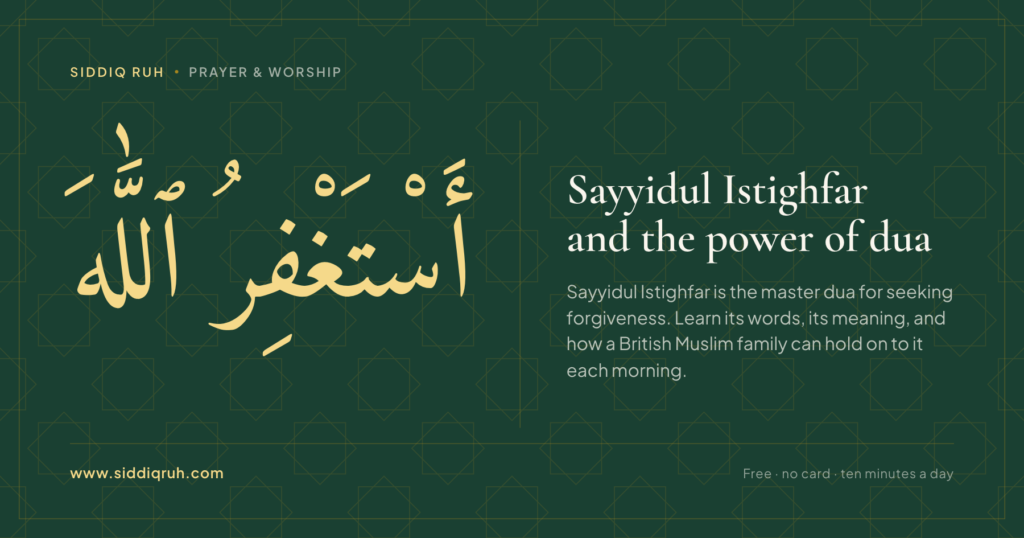
Most of us learn the short one first. Astaghfirullah, muttered under the breath after a sharp word to a child, or in the car on the way home from a conversation we wish had gone differently. That single word does a great deal of quiet work in a Muslim life, and it costs nothing but attention.
There is also a longer supplication, one that the Prophet Muhammad ﷺ described as the master of seeking forgiveness. A surprising number of practising families in Britain have never sat down and learned it properly. It takes maybe three weeks of unhurried effort to hold in memory, and it tends to change the texture of a day once it is there.
What is Sayyidul Istighfar?
Sayyidul Istighfar means “the master of seeking forgiveness”, and it is a specific dua taught by the Prophet ﷺ and recorded in al-Bukhari, the most rigorously checked of the hadith collections. It was narrated by the Companion Shaddad ibn Aws (may Allah be pleased with him), and the Prophet ﷺ taught that whoever says it during the day, believing in it with certainty, and then dies before evening, will be among the people of Paradise, and the same holds for whoever says it at night and dies before morning.
Istighfar (sometimes written astaghfar, from the same root) simply means asking Allah for forgiveness. It sits close to tawba, which is turning back to Allah with regret and the intention not to return to the wrong. One is the request. The other is the turning. In practice they arrive together, and this particular dua holds both.
The words, and what each line is doing
Here is the supplication in transliteration, which is the Arabic written in English letters so you can say it before you can read the script:
“Allahumma anta Rabbi, la ilaha illa anta. Khalaqtani wa ana ‘abduka, wa ana ‘ala ‘ahdika wa wa’dika ma istata’tu. A’udhu bika min sharri ma sana’tu. Abu’u laka bi ni’matika ‘alayya, wa abu’u laka bi dhanbi. Faghfir li, fa innahu la yaghfirudh-dhunuba illa anta.”
And the meaning: “O Allah, You are my Lord. There is no god but You. You created me and I am Your servant, and I keep to Your covenant and Your promise as much as I am able. I seek refuge in You from the evil of what I have done. I acknowledge Your favour upon me, and I acknowledge my sin. So forgive me, for none forgives sins except You.”
Read it again slowly and notice the order. It opens with who Allah is, not with what the one praying wants. Then it establishes the relationship: Creator and servant. Then comes a line that most people find lodges in them permanently, ma istata’tu, “as much as I am able”. It is an admission built into the dua itself that the person saying it has not managed everything they promised. No pretending. Then refuge, then gratitude, then the confession, and only after all of that, the request.
That structure is the lesson as much as the words are. A person who says this honestly in the morning has already acknowledged their own inconsistency before the day has had a chance to prove it.
How many times should I say astaghfirullah each day?
There is no fixed obligatory number. A hadith in al-Bukhari records the Prophet ﷺ saying that he sought Allah’s forgiveness more than seventy times a day, and he was the one with no sin to carry, so that figure is better understood as an invitation than a ceiling.
Many people find a round number helps. A hundred after Fajr, or thirty-three on the walk from the car park to the office door, or whatever quantity survives contact with a real week. Others attach it to a place instead of a count: every time the kettle goes on, every time they lock the front door. The counting matters far less than the not-forgetting.
Sayyidul Istighfar works differently. Because of what the Prophet ﷺ said about saying it morning and evening, most people treat it as twice a day rather than something to repeat in a long string. Once after Fajr, once after Maghrib or before sleeping. Two slots, said with attention, rather than forty said while scrolling.
Dua and istighfar belong together
It is common to separate the two in our heads. Dua is for the things we want, istighfar is for the things we regret. In the Qur’an they are rarely that tidily divided.
In Surah Ghafir, the chapter whose name means The Forgiver (40:60), Allah instructs us to call upon Him with the promise that He will respond. In Surah al-Baqarah, the long second chapter of the Qur’an (2:186), the answer to a question about how near Allah is comes back as a statement that He is near, placed directly in the middle of a passage about supplication. Nothing in either verse suggests the asking has to be beautiful or eloquent or in Arabic. It has to be addressed to the right One.
What istighfar does is clear the line. A person who has been quietly avoiding Allah because of something they did last month will find that their dua feels strange and effortful, the way a conversation does when you owe someone an apology you have not made. Saying sorry first does not make the request more likely to be granted in some mechanical sense. It makes the one praying willing to pray.
Start there if you have drifted. Say the dua badly. Say it in English on the Tube with your eyes open. The Prophet ﷺ taught that supplication is itself an act of worship, which means the attempt is already counted, not just the outcome.
Istighfar opens doors that look unrelated to sin
One of the more striking passages in the Qur’an on this subject is in Surah Nuh, the chapter named after the Prophet Nuh (peace be upon him), who called his people for a very long time with very little response. In verses 10 to 12 he tells them to seek their Lord’s forgiveness, describes Him as ever-forgiving, and then lists what will follow: rain sent down in abundance, increase in wealth and children, gardens and flowing rivers.
Rain and wealth and children. Not one word about the feeling of being forgiven, which is what a modern reader might expect as the reward. The verses tie istighfar to provision, to fertility, to the land itself working again.
Scholars have written a great deal about why. The short version, and the one worth carrying into a Tuesday, is that seeking forgiveness removes an obstruction we cannot see. Plenty of British Muslim families are praying for a house, a child, a spouse, a diagnosis to come back clear, a difficult relative to soften. It is worth asking whether istighfar has a place in that list of efforts, alongside the practical ones. It costs nothing and it is never wasted.
Where it fits in a British weekday
The honest obstacle is not conviction. It is the school run, the commute, the shift pattern, the fact that Maghrib in December arrives in the middle of cooking dinner and in June arrives after the children are asleep.
So anchor it to something immovable. Sayyidul Istighfar after Fajr, while you are already sitting on the prayer mat and the house is still quiet, is the single easiest placement for most people. The second one is more flexible: after Maghrib if your evenings allow it, or as the last thing you say with your head on the pillow if they do not.
Keep the transliteration somewhere your eyes already go. Taped inside a kitchen cupboard, set as a phone lock screen, folded into a wallet. You are not cheating by reading it. Reading it daily for a month is how it ends up memorised, and almost nobody memorises it by deciding to memorise it.
If the full dua is too much this week, take the first line and the last. Allahumma anta Rabbi, la ilaha illa anta, and faghfir li, fa innahu la yaghfirudh-dhunuba illa anta. Add the middle in a fortnight. A short thing you actually say beats a long thing you intend to learn.
Teaching it to children without turning it into a test
Children pick up what they hear repeated, not what they are instructed to learn. If you say this dua out loud in the car on the way to school, two or three times a week, there is a reasonable chance that within a few months one of them says a line of it back to you unprompted.
What is worth explaining, at an age where they can take it, is the ma istata’tu line. Children carry a surprising amount of guilt about not being good enough, and a dua that contains the words “as much as I am able” is genuinely reassuring to a seven year old who thinks Allah expects perfection from them. Tell them the Prophet ﷺ taught these words to grown men who prayed every prayer and fasted every Ramadan, and those men still said them.
Avoid making it a performance. No testing them in front of guests, no comparing one child’s recall with another’s. The aim is a habit they keep at twenty-five, not a party piece at eight.
Starting tonight
Pick the morning slot or the evening one, not both, and keep it for a week. Read it off a piece of paper. Mean the last line especially, because the last line is the whole claim: none forgives sins except Allah.
That is the whole method.